
- Designazione:
- AMB
- Gruppo:
- Shorthair
- Categoria:
- Principale
- Origine :
- USA , Thailand
- Si raccomanda:
- families with children; for active people; for those who are home most of the time (cannot tolerate loneliness); for apartment living.
Breed History
The Burmese cat is one of the most charismatic breeds, known for its "golden" personality. The breed's history has its roots in the East, closely intertwined with the history of Thailand. The first mention of Burmese cats dates back to the 15th century. At that time, she was called the "copper cat" and described as follows: "The character traits possessed by copper cats surpass those of all existing breeds. The color of their coat is bright as copper, their eyes shine like the midday sun. Thanks to these cats, everything dangerous and evil disappears forever…"
The American Burmese as a separate breed came into being almost by accident. In 1930, a retired US Navy physician, Dr. Joseph Thompson, living in San Francisco (California, USA), was given a cat named Wong Mau, brought from the East. She so amazed the doctor with her appearance, sharply different from all known cats, that he decided to create a new breed and enlisted a group of scientists from the local university to develop a breeding program.
As early as 1934, the first representatives of the Burmese breed and a preliminary standard were presented to the CFA, and in 1936 the breed received official status. For a breed whose breeding began only in 1930, this was astounding progress. The popularity of Burmese cats in America grew so rapidly that demand for kittens far exceeded supply.
In 1949, three Burmese cats were brought to England — this marked the beginning of the development of the "European line" of Burmese.
Today, the standards of the "American" Burmese (recognized by CFA and TICA) differ from those of the "European" Burmese (recognized by European systems and others). In the TOPCAT system, both types are recognized, but genetic lines are not mixed.
Appearance
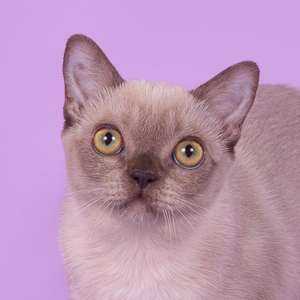
The American Burmese is a compact, medium-sized cat, strongly built, with well-developed musculature. Body weight: females 3–5 kg, males 5–7 kg. It is heavier than it appears relative to its size. The coat is glossy, close-lying, silky, with almost no undercoat. A characteristic feature of the American Burmese is a slightly surprised expression, giving the muzzle a touching, childlike appearance.
Standard — Point Scale (TOPCAT):
| Parameter | Points |
|---|---|
| Head (shape, cheeks, chin) | 25 |
| Eyes (shape, color, expression) | 15 |
| Ears (size, set, shape) | 10 |
| Body (size, boning, musculature) | 25 |
| Legs and paws | 5 |
| Tail | 5 |
| Coat (texture, closeness) | 10 |
| Condition | 5 |
| Total | 100 |
Head: Pleasantly rounded, with no flat surfaces. Full, prominent, and broad cheekbones. Wide distance between the eyes. Profile with a clear break at the base of the nose. A slight bump on the nose bridge is permissible. Strong chin and lower jaw. Correct bite.
Eyes: Large, wide-set, rounded in shape (unlike the European line, which has almond-shaped eyes). Color — from yellow to amber (golden-yellow preferred). Green eyes are not permitted.
Ears: Medium-sized, broad at the base, with rounded tips, set wide apart, slightly vertically. The outer contours of the ears continue the rounded contours of the head.
Neck: Short, strong, muscular.
Body: Compact, medium-sized, "heavy" (weighs more than it appears). Powerful chest, rounded when viewed in profile. Back straight from shoulders to rump.
Legs: Sturdy, proportional to the body.
Paws: Dainty, rounded.
Tail: Straight, medium length, with a narrow base, tapering to a slightly rounded tip.
Coat: Very short, fine, glossy. Lies close to the body, almost no undercoat, reminiscent of satin. The coat hugs the body, emphasizing the graceful figure.
Colors: The American CFA system recognizes four main colors:
| Color (Russian) | Color (English) | Description |
|---|---|---|
| Sable | Sable / Seal Brown | Brown coat with a slight golden sheen; dark brown points. Nose leather brown |
| Champagne | Champagne / Chocolate | Creamy-beige coat; chocolate-brown points. Nose leather cinnamon-colored |
| Blue | Blue | Gray coat with a bluish sheen; blue-gray points. Nose leather and paw pads gray |
| Platinum | Platinum / Lilac | Platinum-colored coat; grayish-pink points. Nose leather and paw pads pink with a lavender sheen |
In all colors, the lower part of the body is slightly lighter than the back and limbs. Kittens and young cats may have a faint tabby pattern and a slightly lighter body color, which disappears with age.
Faults: Too light bone structure; too long and thin tail; flat forehead; coat that does not lie close or is too thick or too long; pale eye color.
Disqualification: Green eyes; white spots anywhere on the coat; incorrect bite.
Disqualification for all breeds: Amputated claws, cryptorchidism, deafness, noticeable bone deformities.
Personality and Character
The American Burmese has an active and energetic temperament, friendliness, and devotion to its owner, which is why it is often called a "cat with a dog's personality." The Burmese is the epitome of elegance, grace, and tact.
These cats are people-oriented: they love their owner so much that they are ready to be in contact with them every minute. They are sociable, very attached, never show aggression toward people, do not extend their claws or scratch. The Burmese does not like loneliness, so it is immensely happy if it has a companion at home — a child, another cat, or a dog.
They have high intelligence: you can talk to a Burmese; she understands human speech and can even "answer" — these cats are very talkative. If desired, they can be taught simple commands. Playfulness remains into old age. Burmese cats live up to 16 years.
Care and Maintenance
Caring for an American Burmese is easy. Due to the lack of undercoat, the cat hardly sheds.
- Coat: Brushing once a week with a rubber brush or silicone glove is sufficient. To maintain shine, the coat can be wiped with soft natural chamois.
- Bathing: Only as needed (if the cat gets dirty or before a show).
- Hygiene: Regular ear checks, teeth brushing (especially important as the breed is prone to dental problems), nail trimming every 2-3 weeks.
- Space: For an active and curious Burmese, it is necessary to equip a play area with a scratching post, shelves, and sleeping places at different levels. Burmese love to climb high and observe what is happening.
Nutrition
Nutrition must be balanced to maintain muscle tone and coat shine. Super-premium dry food for active breeds or a high-quality natural meat-based diet is recommended.
Health
Veterinary communities have recognized the American Burmese as one of the healthiest breeds. Main issues:
- Teeth: Predisposition to gingivitis and dental calculus — regular veterinary examination of the oral cavity is necessary.
- Hypokalemia (periodic paralysis caused by low potassium levels) — a hereditary disease found in some lines.
- Craniofacial defect (congenital head deformity) — rare.
Life expectancy: 15–20 years.
Breeding
Permissible outcrosses: Currently, outcrossing with other breeds is not permitted. Crossing American and European lines of Burmese is not recommended (completely prohibited in CFA).
Important: When breeding, matings between two cats with extremely short muzzles (contemporary type) should be avoided to prevent breathing problems and tearing.
Breeds Created Using Burmese Cats
- Bombay (American and Australian)
- Burmilla
- Asian (all varieties)
- Singapura
- Tonkinese
- Tiffanie (Asian Semi-longhair)
- Australian Mist
Alternative and obsolete breed names
- Burma
- Copper (Copper cat)
- Supalak (or Suphalak)
- Chống dòng — obsolete Thai name
- Malay — term used in Britain for solid-colored Burmese cats, except chocolate